Domkaspot V1
Domkaspot went live on the 2nd of January, 2026. We missed our New Year’s Day target by exactly twenty-four hours, but for a good reason: we weren't just launching a database of walls and windows. We were launching a promise to the thousands of students and expats in Poland that finding a home and the people you share it with shouldn't feel like a high-stakes endurance test. It took months of quiet beta testing, countless design pivots, and more than a few late-night "hair-pulling" sessions to get the bridge between Natural Search and Social Trust just right. This is the story of how we are setting a new standard for urban living.
(Client)
Domkaspot
(TIMELINE)
2 months
(SERVICES)
UI/UX Design
Copywriting
Product design
Motion design storyboard
THE INTRO
Poland is currently facing one of the most acute housing crises in Europe. According to the National Bank of Poland (NBP) and reports from PKO Bank Polski, the country enters 2026 with a structural deficit estimated between 1.5 and 2.2 million housing units.
Looking toward 2035, verified market forecasts from JLL and Cushman & Wakefield suggest that while institutional investment (PRS) is growing, it will not be enough to offset the urban concentration in hubs like Warsaw, Kraków, and Wrocław. By 2035, the demand for flexible, co-living, and student-centric housing is expected to surge by 40%, driven by international talent and a permanent shift away from traditional home ownership among Gen Z and Alpha.

THE CHALLENGE
Despite the high demand, the "search-to-move-in" journey in Poland is plagued by systemic issues that treat housing like a transaction rather than a human need.
Shared housing is the only viable option for most students, yet traditional platforms provide zero data on social compatibility.
This leads to high turnover and "living room tension" when an 8 AM student is matched with a 3 AM freelancer.
International users are often viewed as "high-risk" by local landlords. Without a bridge to verify identity, check compatibility, and communicate safely, both sides remain locked in a cycle of suspicion.
Our goal with Domkaspot was twofold:
Unlock Supply: Create a high-trust pipeline that makes existing supply more "available" by removing the friction and fear landlords have when renting to international students and expats.
Revolutionize Shared Housing: Move beyond "flatmate roulette." In a market where space is a premium, we aimed to optimize shared living through an AI-driven compatibility engine, ensuring that limited housing supply is occupied by people who actually thrive together.
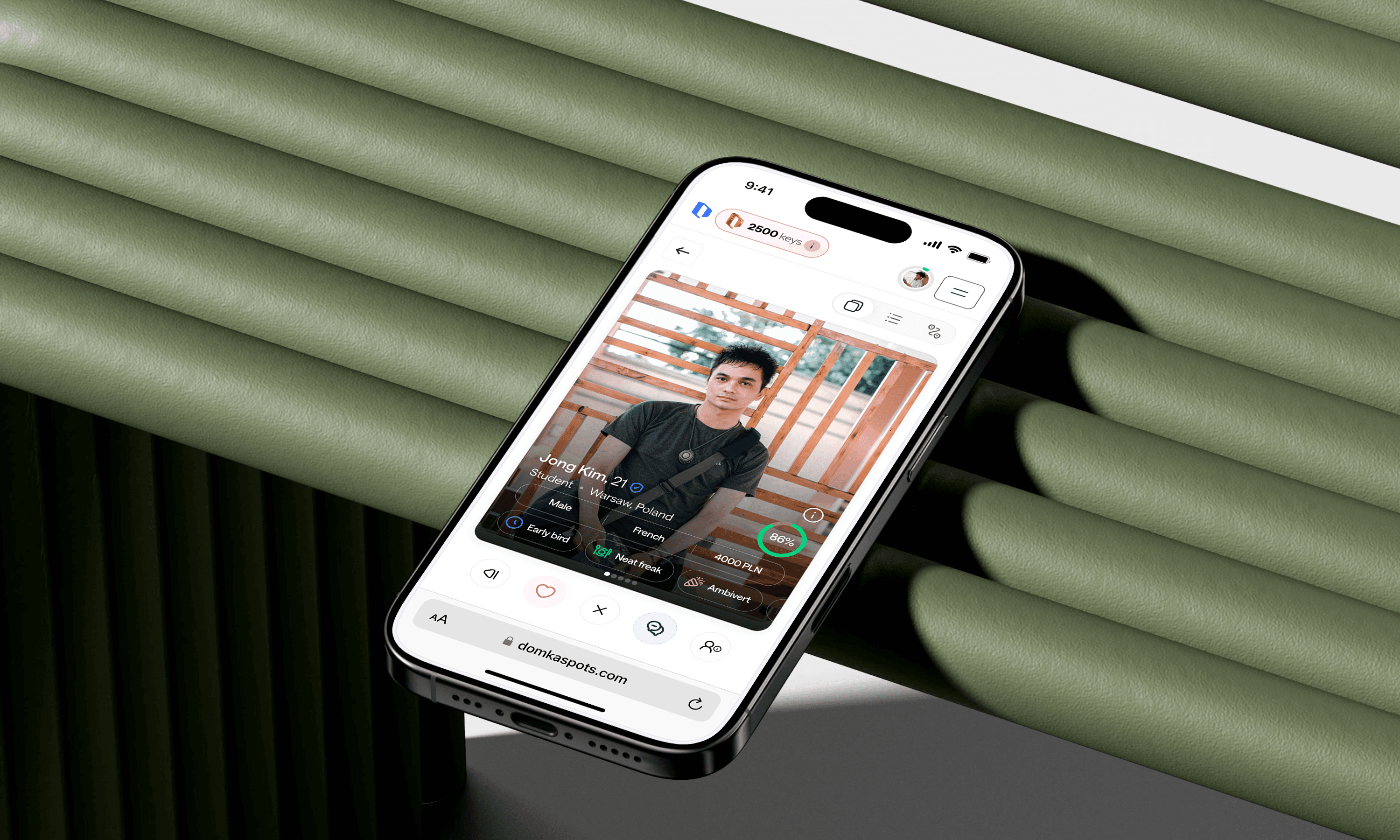
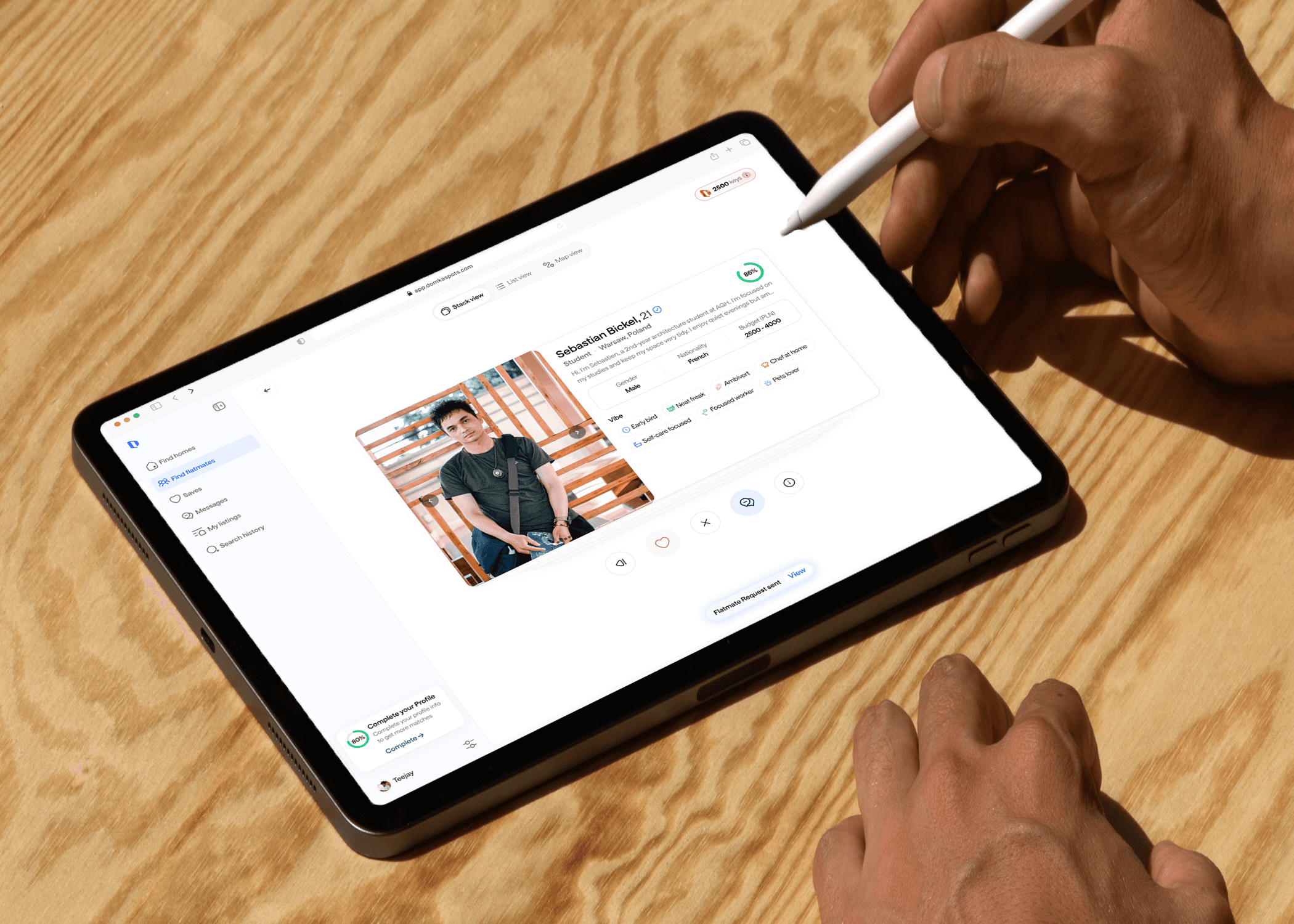
THE PROCESS
To build the future of urban living, I started by analyzing the present. I conducted a comprehensive competitive audit of global players Airbnb, Roomi, and Roomster doing something similar in the house sharing market. My research revealed a critical flaw, Current platforms treat roommates like inventory, not human beings.
Apps like Roomi and Roomster are designed to generate Surface-Level Leads. They excel at letting you send a generic message, but they provide zero insight into the person behind the listing. We realized that these platforms stop working the moment the lease is signed.
The real tragedy of the current market isn't just the search,it’s the "Post-Move-In Reality Shock."
Because these apps don't account for social compatibility, users are forced to make life-altering decisions. It’s only after the boxes are unpacked and the first week passes that they discover the "total mismatch":
The "Early Bird" medical student realizes their new flatmate is a late-night gamer,
The "Clean-Freak" expat finds out their roommate has a "wash-it-next-week" policy for dishes.
These aren't just small annoyances,they are the leading causes of rental burnout, broken leases, and mental stress for those far from home.
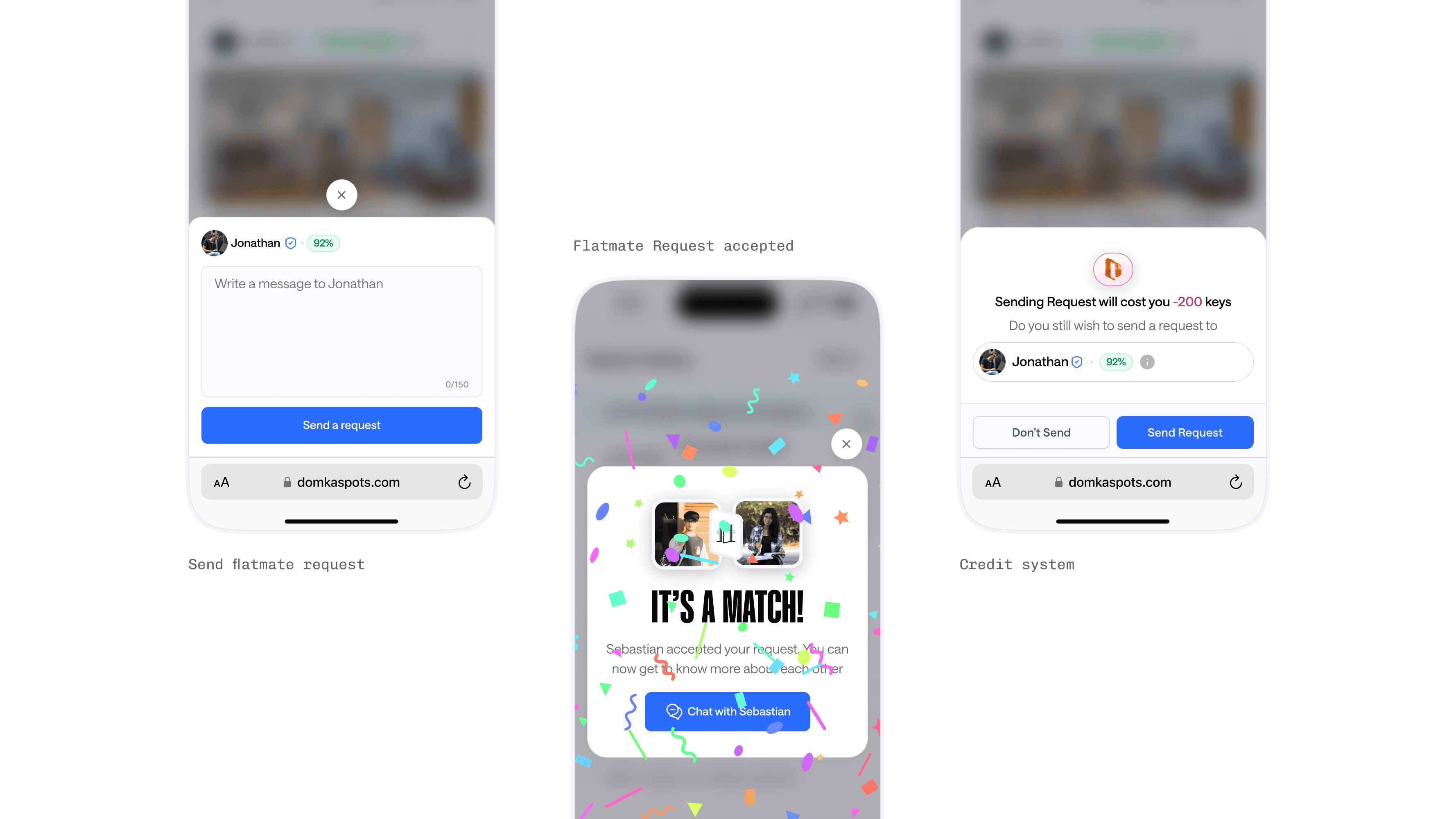
THE PROCESS CONT.
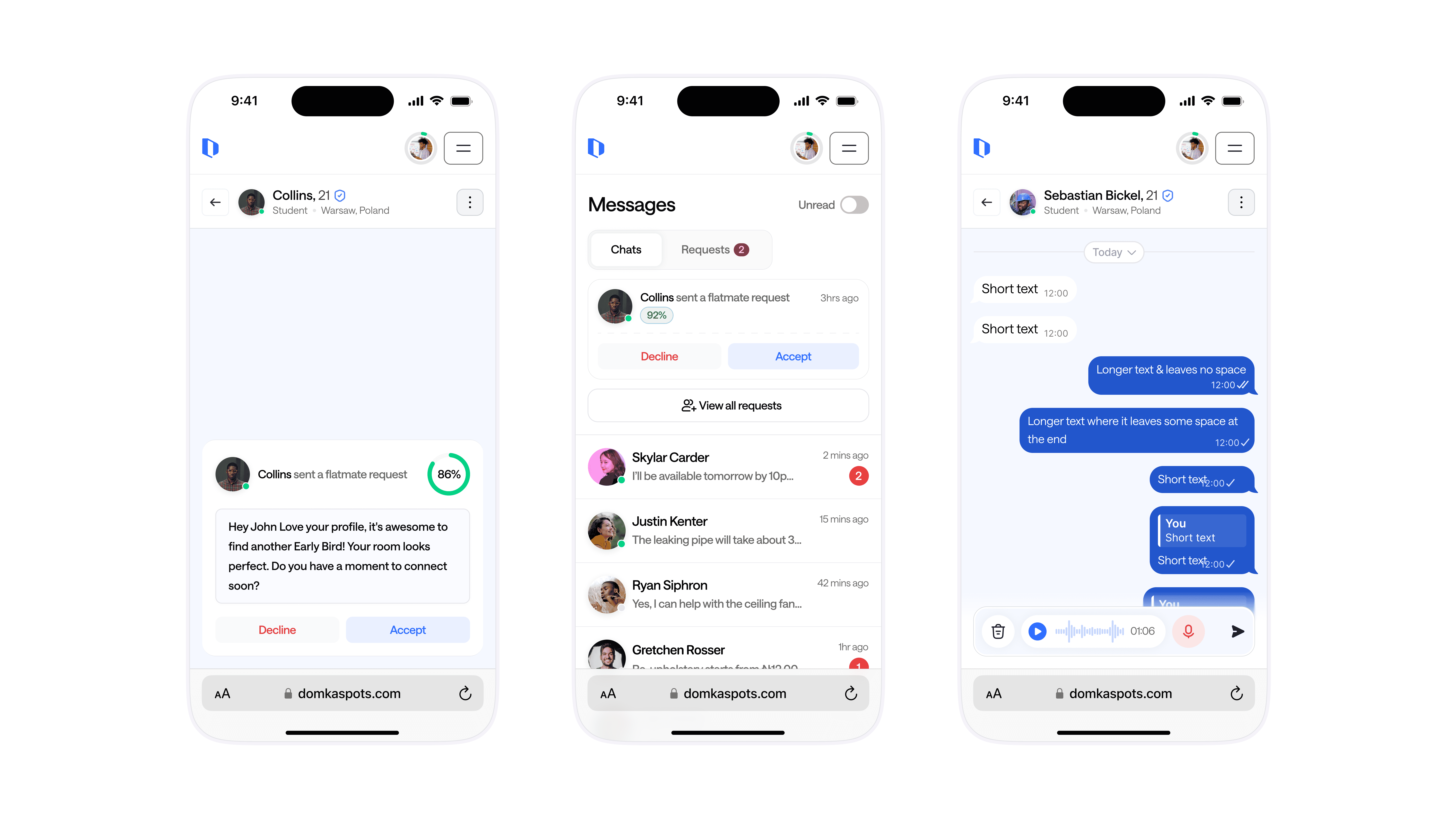
The kickoff led us to a radical realization: To revolutionize housing, we had to eliminate the "blind introduction." We decided that Domkaspot wouldn't just be a place to find "a room." It would be a place to find a compatible lifestyle.
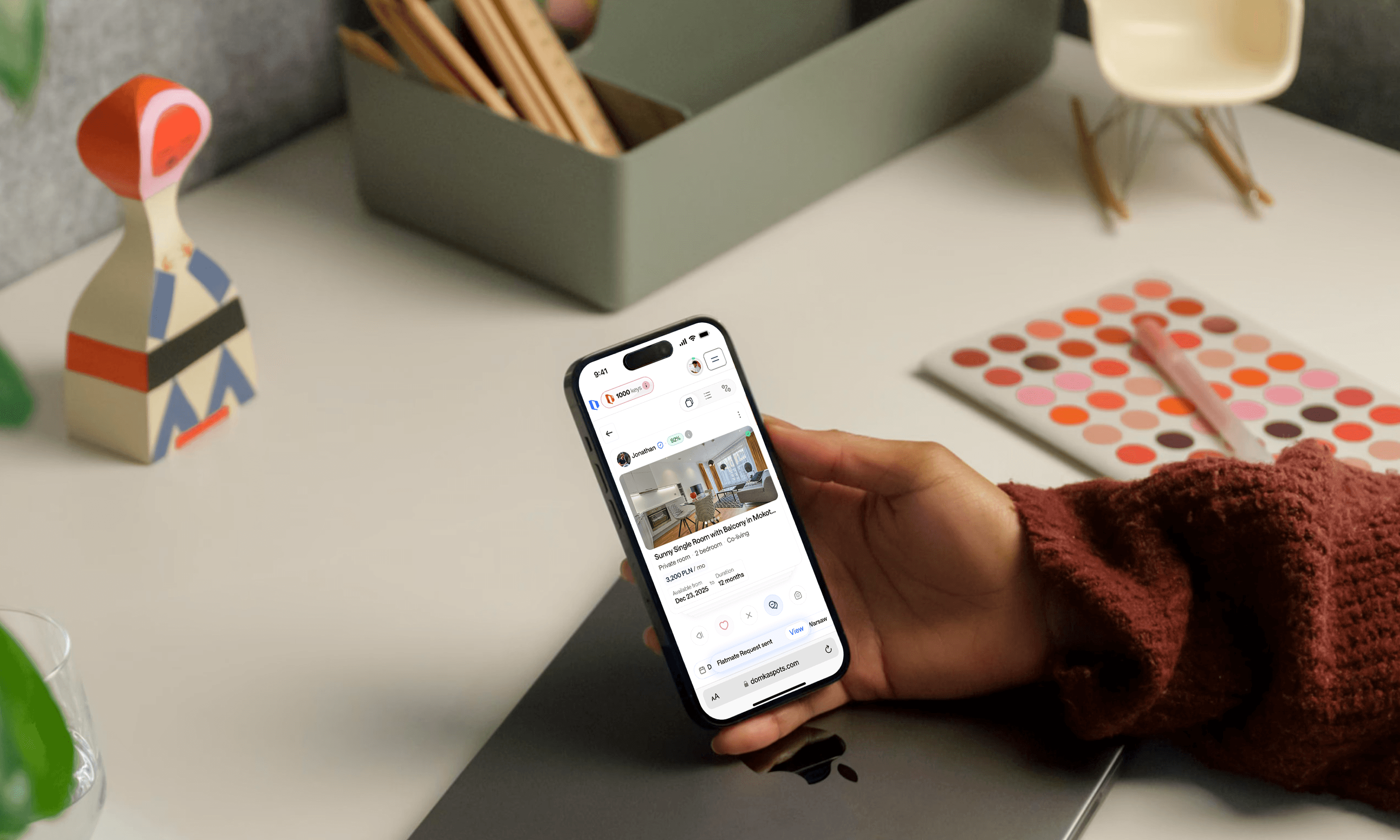
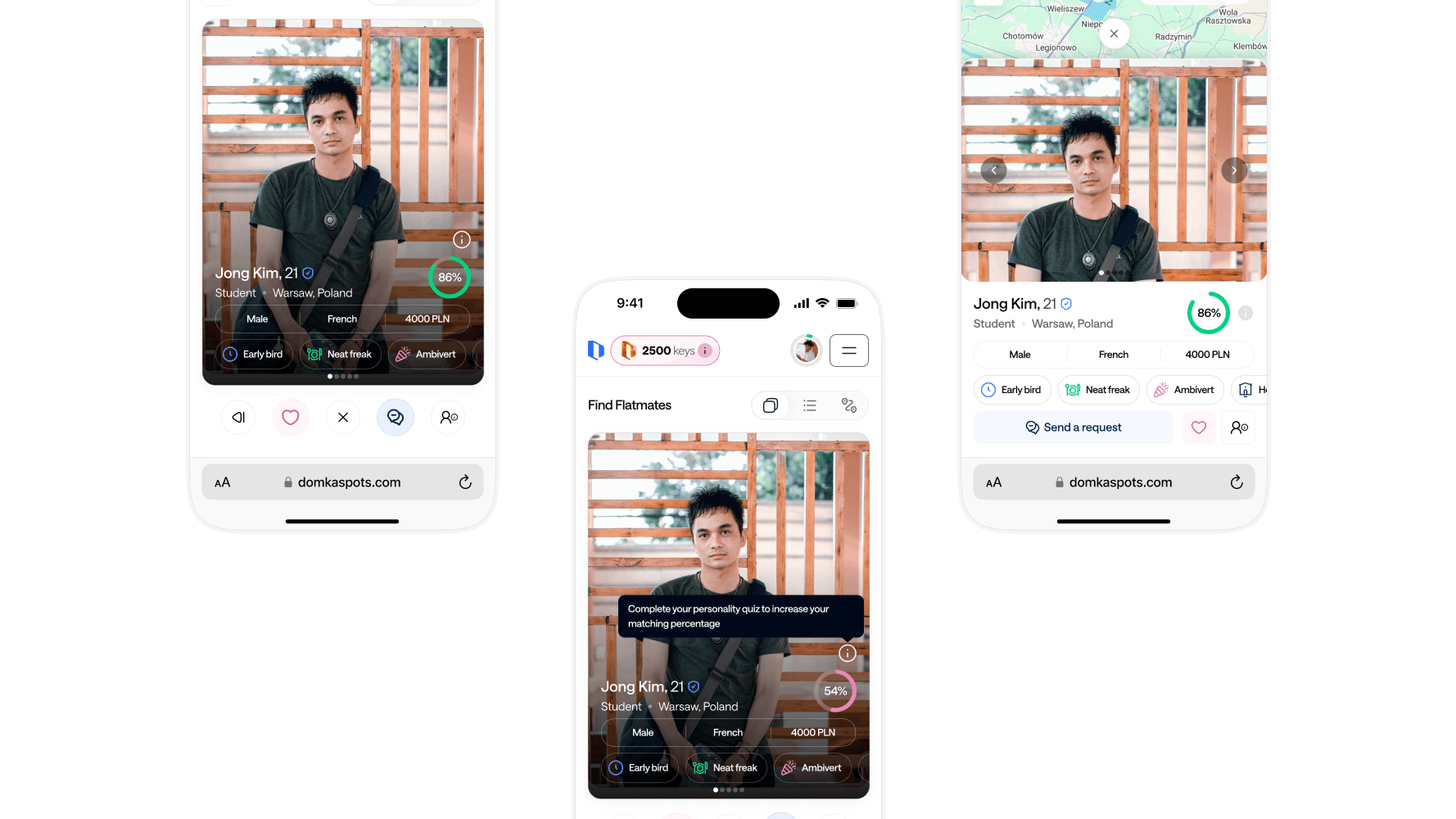
We moved the "Vibe Check" from the first month of living together to the first second of searching
The Goal: No more "Reality Shock." You should know who your flatmates are before you even see the kitchen.
But this couldn’t be solved easily. In our beta phase, we hit a significant wall. To fulfill our promise of a "High Compatibility Matching," the system required deep data on user habits, everything from sleep schedules to social preferences.
The result was a 40% drop-off during onboarding. Users felt overwhelmed by the "Compatibility Quiz." It felt like a chore rather than a path to a new home. We faced a paradox: How do we provide high-value results without forcing users through a high-friction data entry process?
PROCESS CONT.
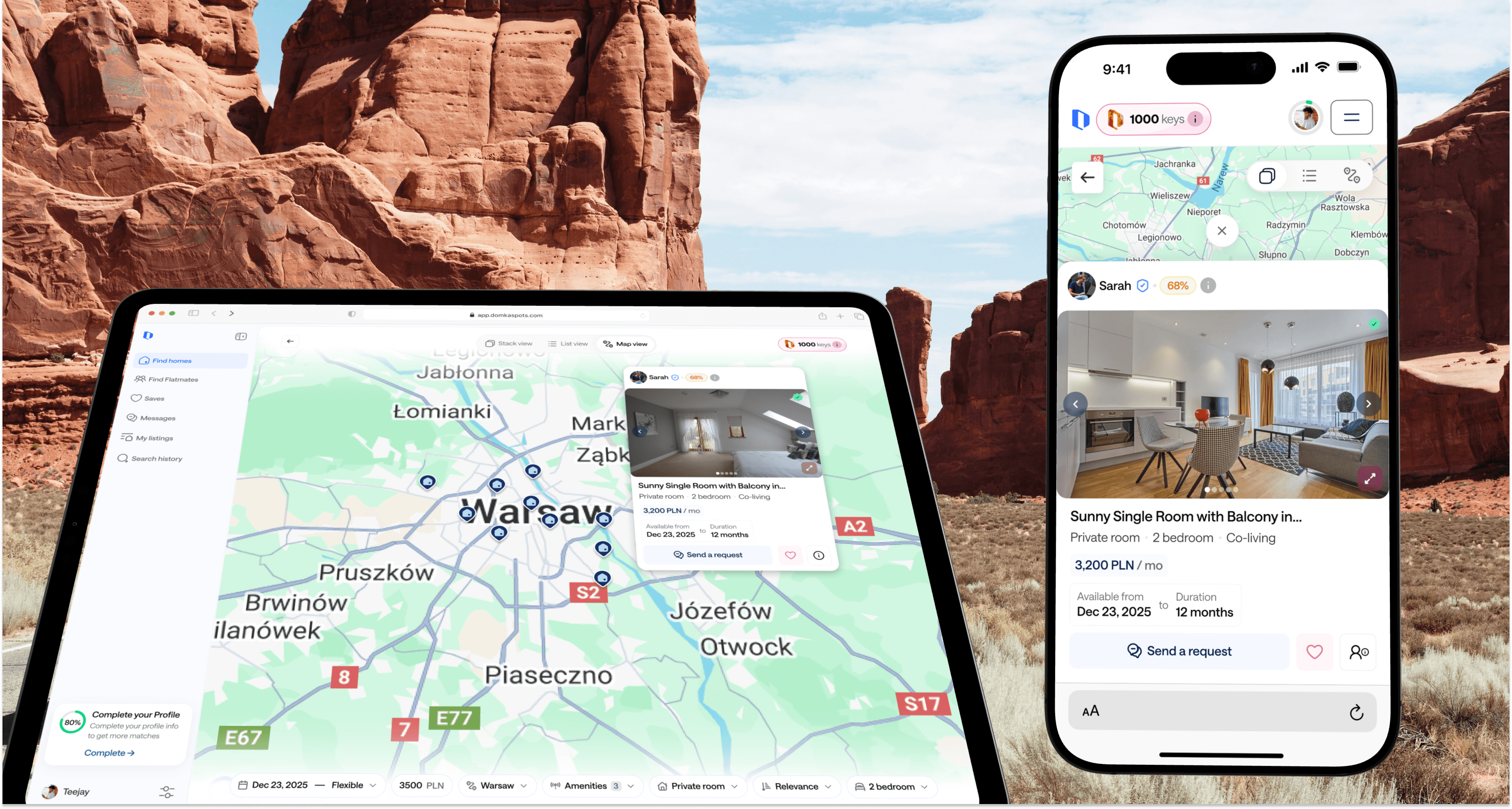
We went back to the drawing board and shifted our strategy from "Mandatory Data Entry" to "Value-Driven Incentives." We realized that users are happy to give data if they can see the immediate impact on their results.
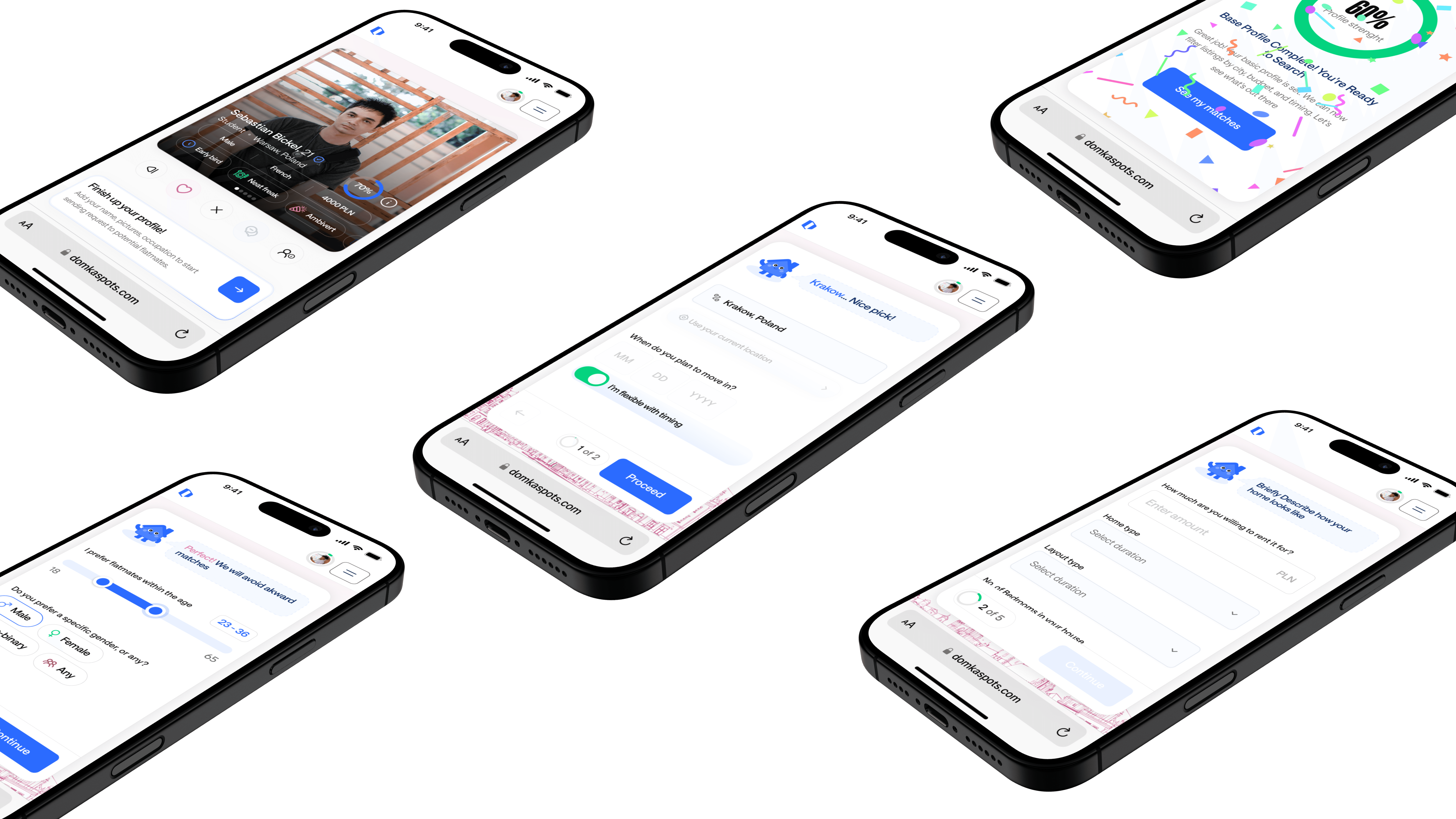
We re-engineered the onboarding into a 3-Tiered Gamified Journey:
1. The "Quick-Start" Tier (The Hook)
Instead of a long quiz, we start with 3 essential questions. This instantly unlocks the search results but caps the compatibility score at 50–60%.
The Goal: Immediate value. Show the user that the app works and that there are people "like them" in the city.
2. The "Profile Strength" Meter (The Motivation)
We introduced a dynamic Profile Strength Meter. As users see potential matches, we prompt them: "Want to see if you're a 90% match with Marek? Complete your profile"
3. The "Expert" Tier (The Reward)
As users complete the second and third segments of the quiz, their compatibility accuracy climbs toward 95%. This creates a "Dopamine Loop"—the more they tell us, the more "perfect" their shortlist becomes.
PROCESS CONT.
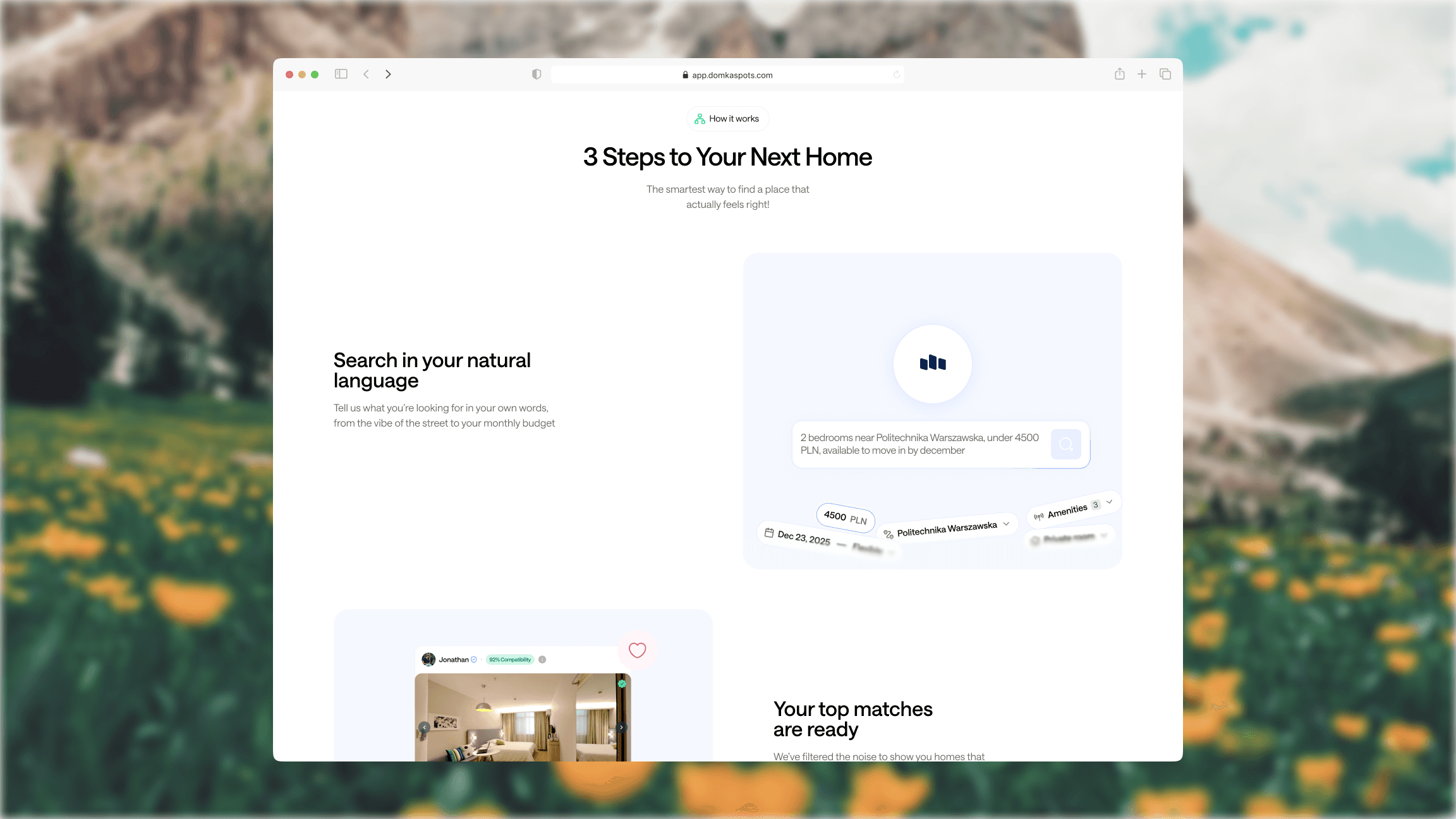
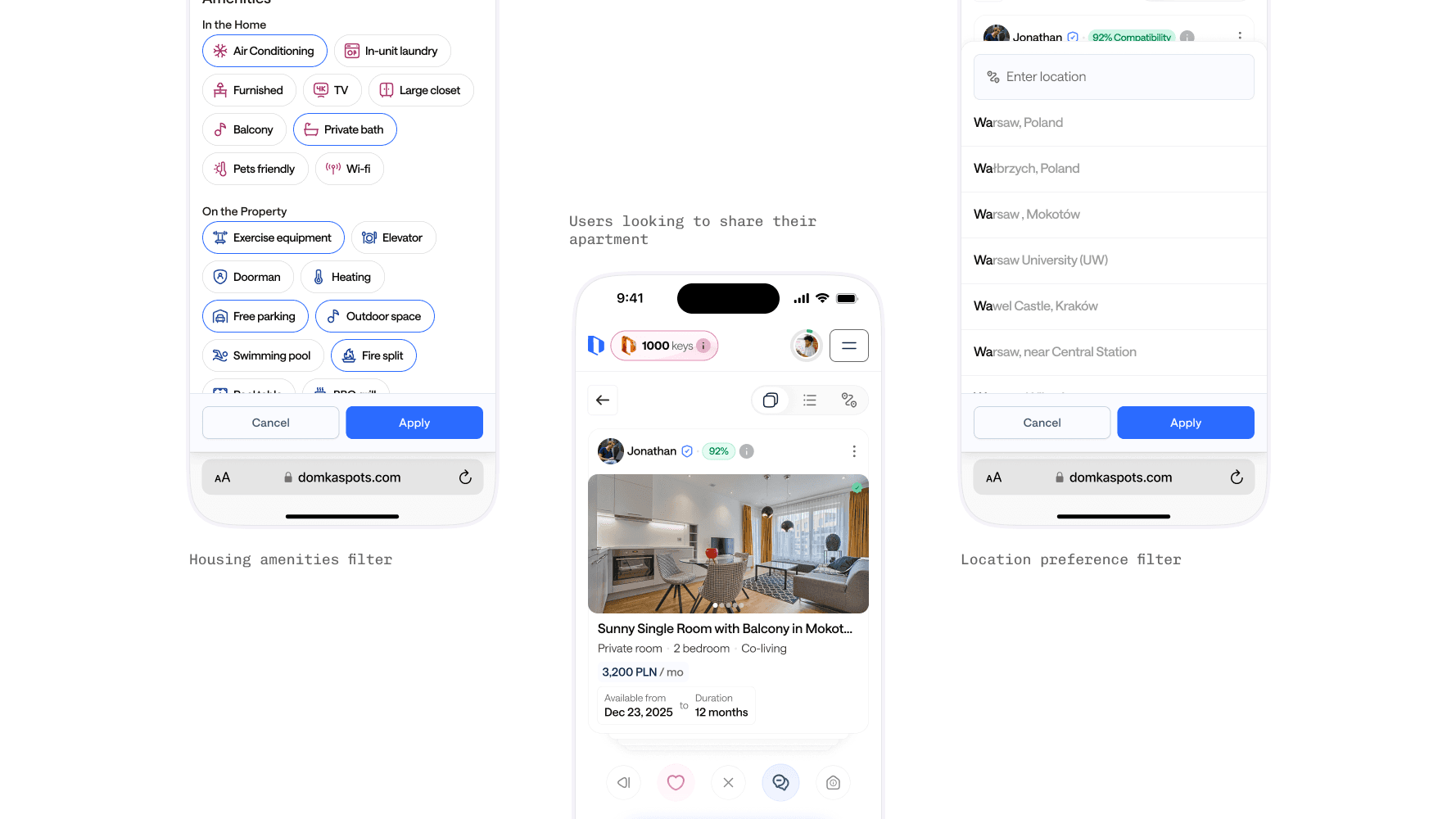
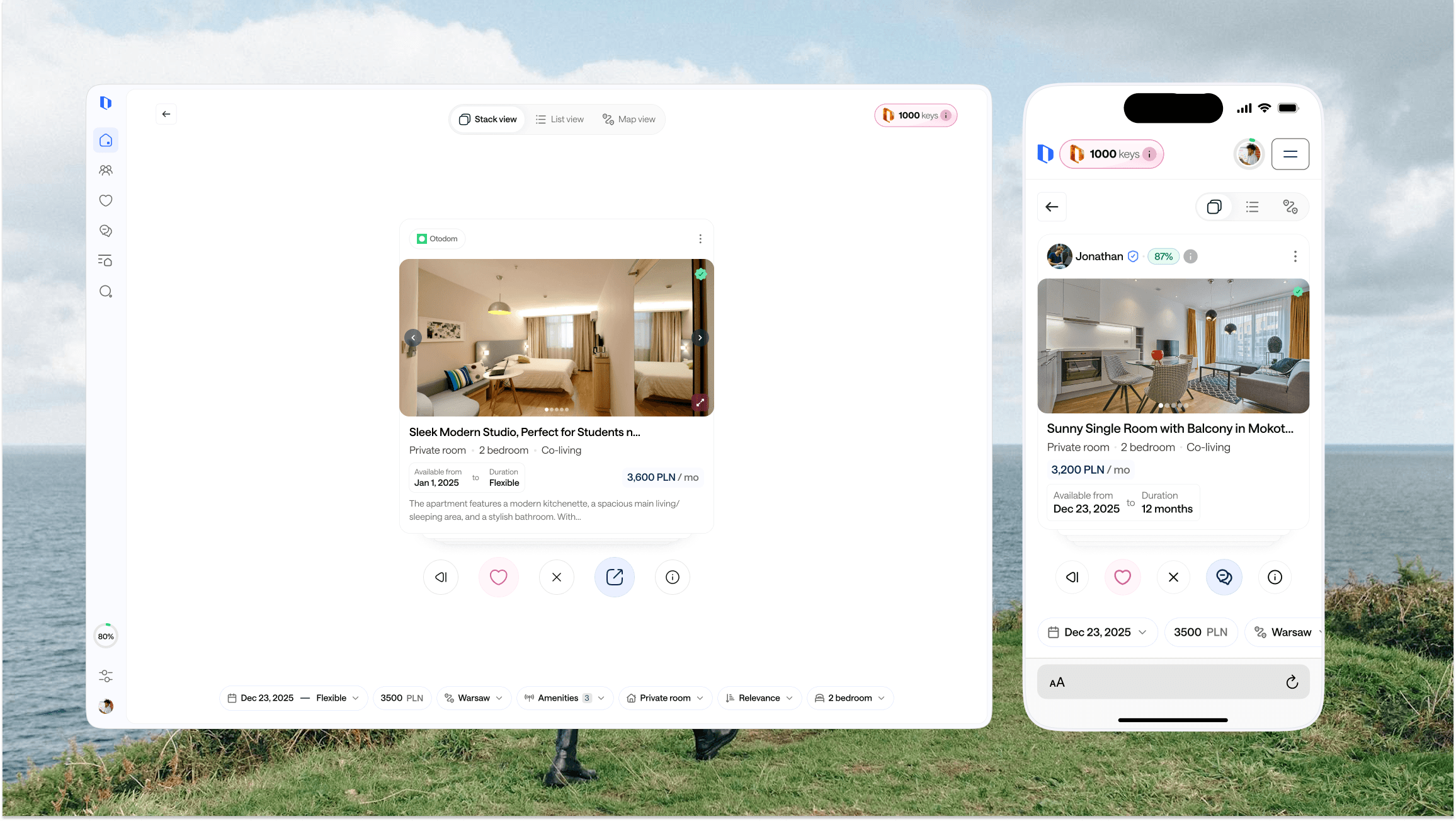
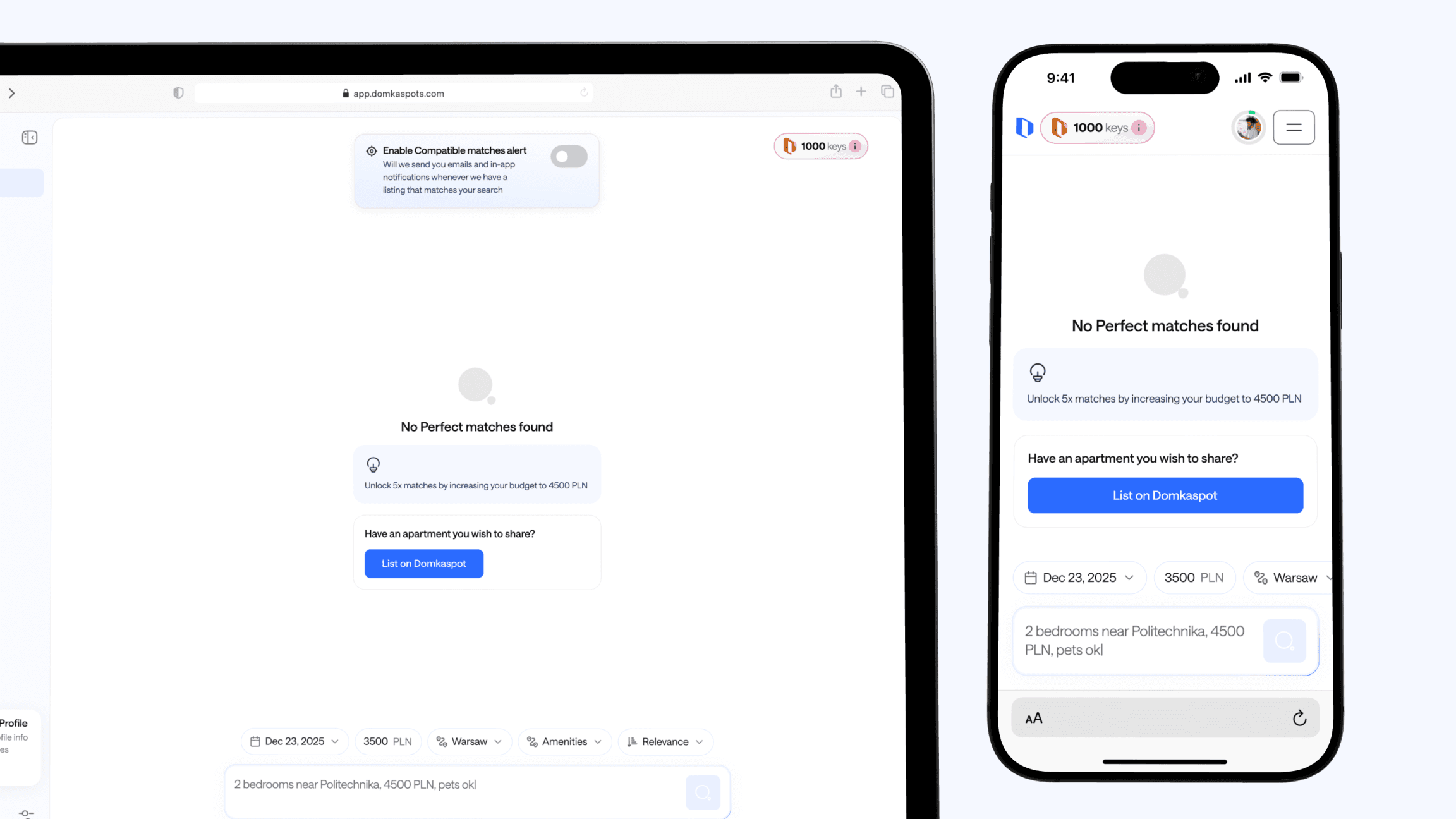
We integrated a natural language engine that allows users to search exactly how they think. Instead of picking a radius on a map, an expat can type: "A quiet studio near the Google office, pet-friendly, under 4000 PLN."
As the user types, the system instantly "decodes" the prompt and populates Smart Filters. Users can easily tweak specific parameters (like increasing the budget by 200 PLN) directly from the generated filters without re-typing their entire prompt. This creates a "Search-to-Tweak" loop that is 3x faster than traditional manual filtering.
LESSON
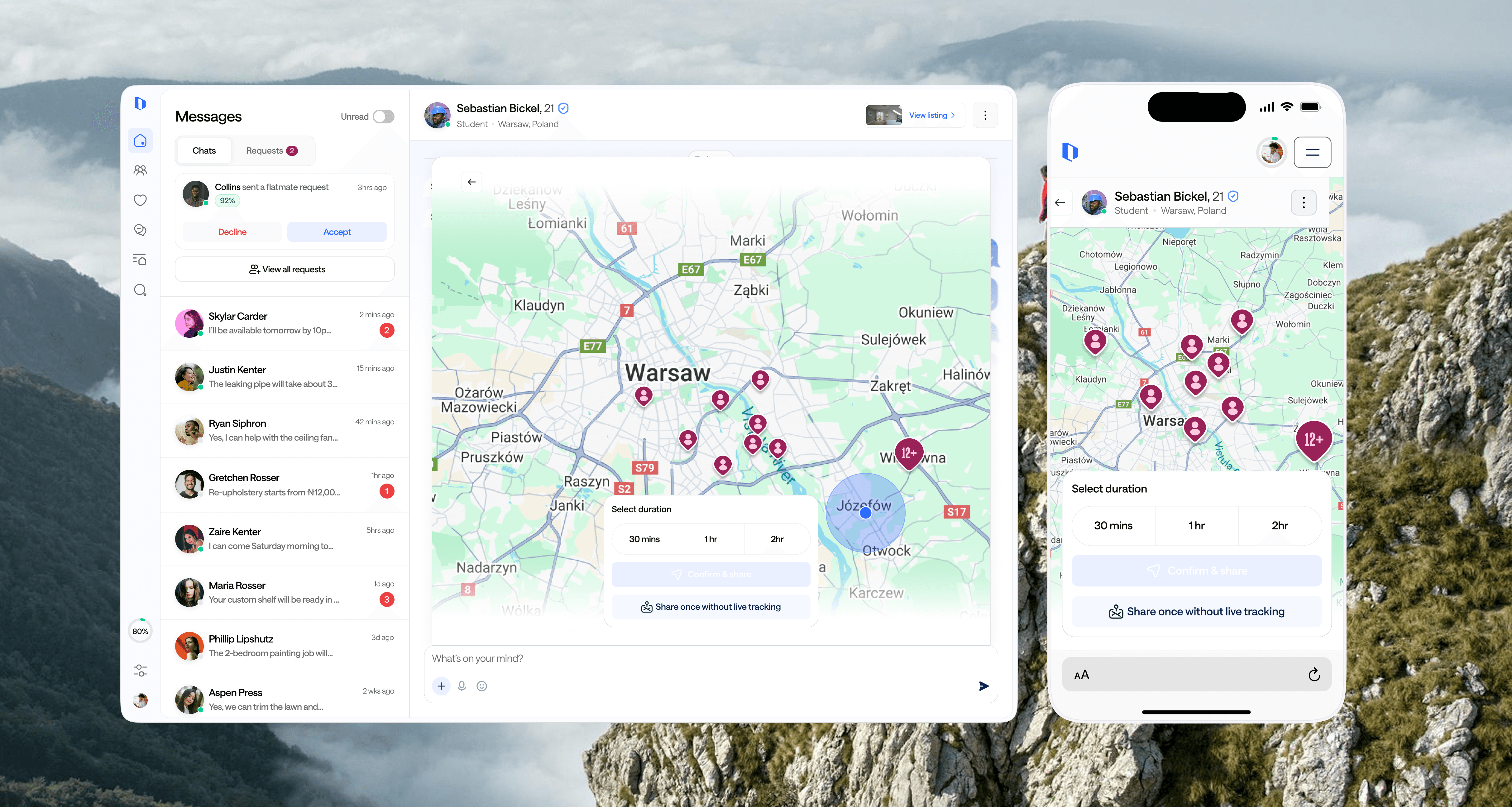
Domkaspot was born out of a specific kind of frustration, the kind that comes from staring at 20 browser tabs of listings at 2 AM. We didn’t want to build just another "real estate app." We wanted to build a way out of the "second job" of house hunting. By focusing on NLP-driven search and human compatibility, we shifted the focus from the bricks and mortar to the people inside them. This project taught me that the most powerful UI isn't the one with the most features, but the one that gives the user their time and sanity back
THANKS FOR READING👋
This case study is a snapshot of Build 1.0, but the "design-fights" and the late-night iterations are still very much alive. Domkaspot is out there now, helping students and expats find their compatible flatmate in a city that used to feel closed off to them. I’m incredibly grateful to the team that helped turn it into a living, breathing product. If you’re looking for someone to help tackle a messy, broken industry with a mix of data and soul, I’m ready for the next challenge. Let’s build something that actually matters.